
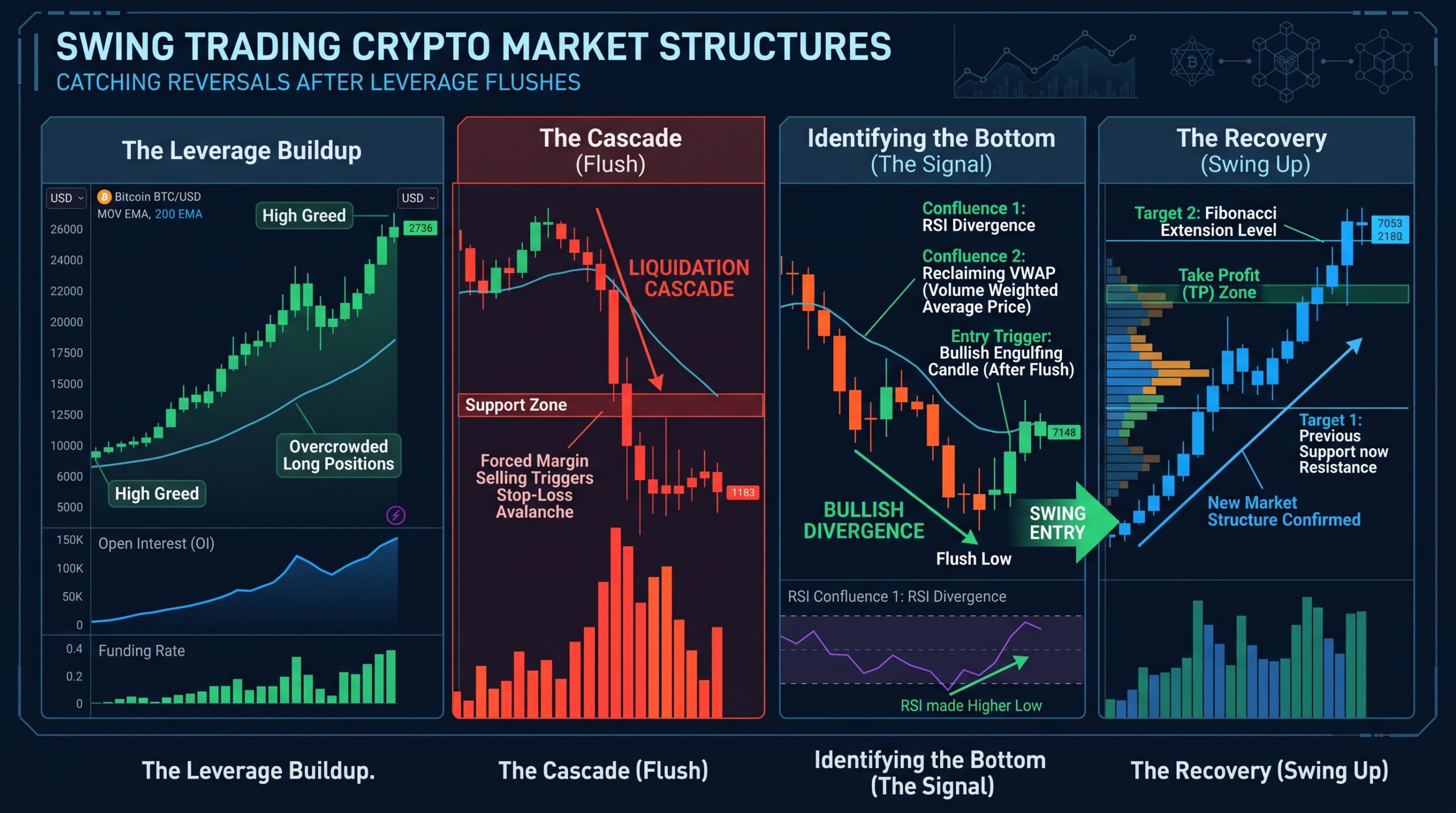
You have likely experienced that gut-wrenching moment when the price of your favorite altcoin suddenly drops 10% in five minutes, only to recover every cent of that loss just as quickly. We have all been there. You see the chart dump, you panic-sell the bottom, and then you watch in agony as the market v-shapes back up without you. This isn’t just “volatility”—it is a surgically precise event known as a leverage flush.
If you are trying to swing trade without understanding how these liquidity events shape market structure, you are essentially providing the fuel for the big players to profit. These “flushes” are not accidents; they are engineered mechanics designed to clear out over-leveraged positions so the market can move in its true direction. If you want to survive, you need to learn how to identify these traps and, more importantly, how to catch the reversal on the other side.
Understanding the “Liquidity Trap”
Market makers and high-frequency trading algorithms aren’t looking to “beat” you; they are looking to trigger your stop-losses. When the market builds up too much leverage—too many retail traders going long at the same price—the price must dip to tap into those sell orders. This is the “leverage flush,” and it is the most common precursor to a genuine trend reversal.
Expert Insight: When you see a massive, violent wick on the chart that instantly reverses, you are looking at a liquidity event. Instead of viewing it as a breakdown, view it as a clearing operation. The market has just “eaten” the weak hands, and now, with the leverage gone, the path of least resistance is often in the direction of the original trend.
Mapping the Structure of a Flush
To catch the reversal, you need to look at the “Order Flow” rather than just the candles. A classic flush follows a specific pattern: a consolidation zone, a sudden expansion move that breaks a key support level, and then a rapid exhaustion of volume. The volume is the key—if the price dumps on massive volume but closes back inside the range, the flush is over.
Personal Example: I once waited for a daily close to confirm a “breakdown” below a key support level. By the time I saw the close, I had already missed the entire reversal. Now, I focus on the “lower timeframe” behavior. If I see a 15-minute candle dump and then instantly reclaim the support level with heavy volume, that is my entry signal. I don’t wait for the daily; I enter on the reclaim of the structure.
Building Your Reversal Strategy
Catching the reversal requires nerves of steel. You aren’t buying the breakdown; you are buying the failed breakdown. The goal is to place your entry just above the support level that was briefly pierced, keeping your stop-loss tight, just below the extreme low of the wick.
Expert Insight: Never try to catch the “falling knife” exactly at the bottom. Wait for the market to give you a “higher low” on a smaller timeframe. Once the market confirms it can no longer make new lows despite the selling pressure, that is your high-probability setup. Let the sellers exhaust themselves first—your job is to be the buyer who enters when they have nothing left to sell.
Avoiding the “Fake Out”
Not every flush is a bottom. Sometimes, a leverage flush is just the start of a much deeper correction. To protect yourself, always cross-reference your structural setup with the broader market trend. If the overall macro trend is bearish and you are trying to catch a flush on a weak altcoin, you are playing with fire.
Expert Insight: Always check the “Open Interest” (OI) data on your exchange. If the price dumps but Open Interest stays flat or rises, it means new leverage is entering—that is not a flush, that is a trend change. You want to see the OI drop sharply as the price dips; that confirms the “flushing” of the leverage you were looking for.
Swing trading the flush is about patience and recognizing that the market’s primary job is to deceive you. Stop fearing the sudden drop and start seeing it as a necessary clearing event. By focusing on volume, monitoring Open Interest, and waiting for the “reclaim” of structure, you turn these volatile events into your most profitable setups. Discipline is your only edge, so stay patient and wait for the market to prove its intentions before you commit your capital.
FAQ
Why does Open Interest (OI) matter so much in a flush? Open Interest tells you if people are still holding leveraged positions. If OI drops during a price drop, it means the leverage has been liquidated. If OI rises, it means new traders are piling into the move, which usually signals a trend reversal, not a flush.
Is catching a flush the same as “buying the dip”? No. Buying the dip is typically done during a slow, healthy pullback. Catching a flush is a high-octane move to capture the massive, volatile “V-shape” recovery after a liquidity event.
What is the “reclaim” of structure? It is when the price falls below a support level, briefly stays there, and then moves back above that same level. It proves that the sellers were unable to sustain the price below support, which is a very bullish signal.
Can I use this strategy on high-leverage futures? You can, but it is extremely risky. Because flushes are designed to trigger stops, using high leverage here is a recipe for liquidation. Stick to low leverage or spot when catching these reversals.