
You have likely spent hours analyzing charts, only to find that your trading experience is being held back by a platform that freezes during volatility or charges exorbitant fees. We have all faced the frustration of an exchange that promises “deep liquidity” but leaves you battling slippage on every trade. In the fast-paced crypto environment of 2026, where you choose to park your capital is just as important as the strategy you use to trade it.
When the market starts to swing, you need more than just a place to buy and sell. You need a robust ecosystem that prioritizes your security without sacrificing the tools required for professional execution. Let’s break down how to evaluate the top centralized exchanges (CEXs) so you can trade with confidence.
Security: The Bedrock of Your Trading Foundation
Before you look at flashy features or low fees, you must assess the exchange’s security posture. In 2026, the gold standard for CEX security involves more than just a password. You want to see platforms that implement FIDO2-compliant 2FA (passkeys), which effectively eliminate the risk of SIM-swapping and traditional phishing.
Look for exchanges that provide regular, third-party Proof-of-Reserves (PoR) audits. This transparency ensures that the exchange is holding your assets 1:1, rather than engaging in risky fractional reserve practices. Platforms like Kraken, Coinbase, and OKX have led the way here, making it easy for you to verify their holdings through public cryptographic proof.
Expert Insight: Never store your entire portfolio on an exchange. Even the safest platforms are custodial, meaning you don’t technically hold the keys to your assets. Use an exchange as a “trading engine,” not a long-term “savings vault.” Move your core holdings to a hardware wallet as soon as you hit your profit targets.
Liquidity: Why Depth Matters for Your Execution
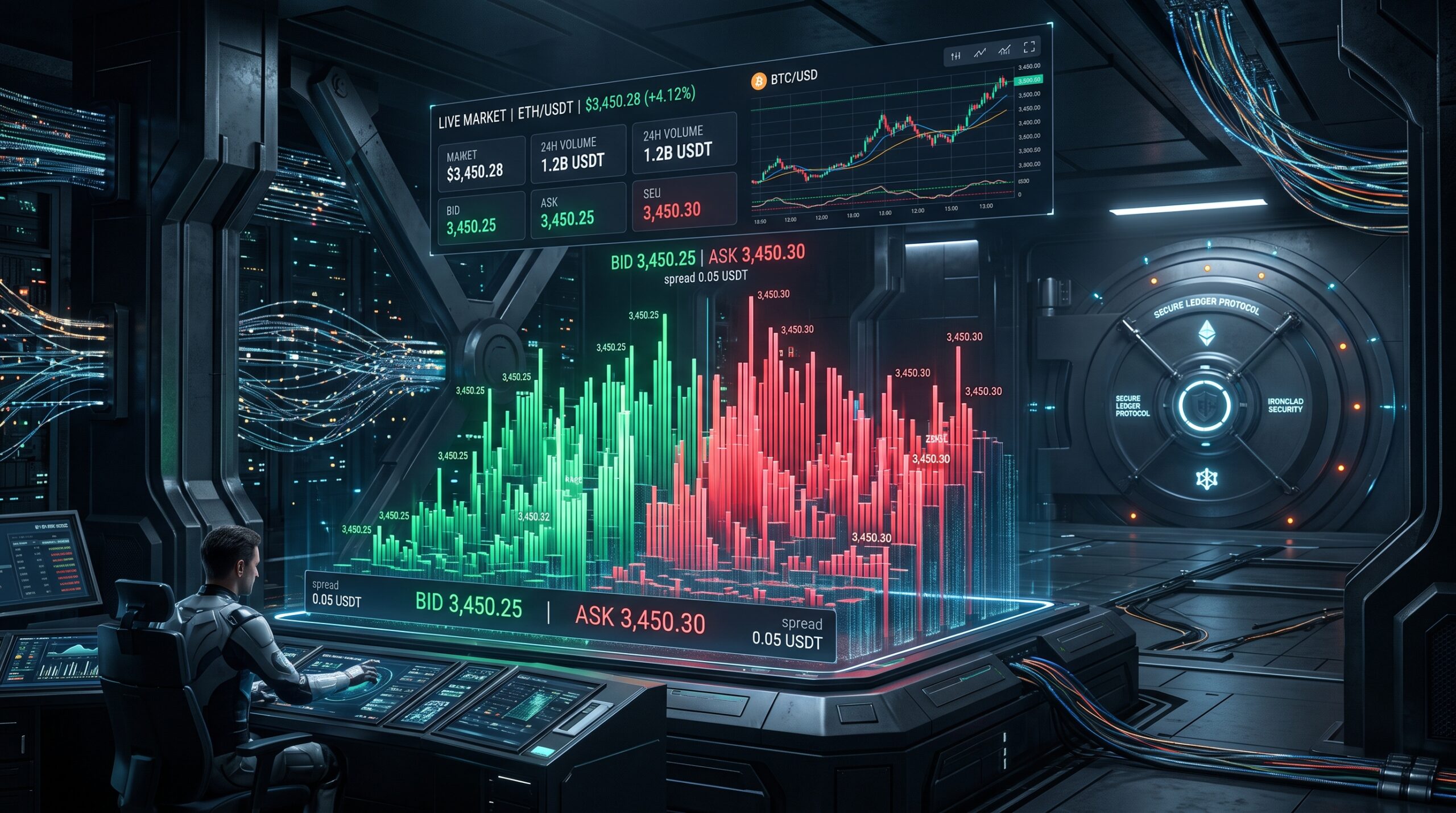
Liquidity is the lifeblood of your trade. When an exchange has “deep” liquidity, it means there is a massive volume of buy and sell orders waiting at every price level. This depth is what prevents your orders from causing “slippage”—the difference between the price you want and the price you actually get.
If you are executing large orders, slippage can silently destroy your profitability. Exchanges like Binance, Bybit, and OKX are renowned for their high-frequency matching engines that maintain tight spreads even when the market is under extreme pressure. Before you commit to a platform, check the “order book depth” for the specific pairs you trade most.
Expert Insight: If you see a chart price of $50,000 but the sell orders in the order book jump from $50,000 to $50,100, that gap is your enemy. A liquid exchange will have a smooth, “thick” order book where prices move in tiny increments. Always test your platform with a small “market order” to see how the price executes relative to the chart.
Features That Give You an Edge
The “best” exchange is the one that fits your specific workflow. Are you a passive holder, or are you an active, leverage-focused trader? If you are an active trader, you need an exchange that supports advanced order types like trailing stop-losses, Take-Profit/Stop-Loss (TP/SL) automation, and API access for algorithmic trading.
In 2026, many top platforms have integrated AI-driven tools that help you identify entry zones or monitor sentiment shifts in real-time. Platforms like BingX have gained popularity for “copy trading,” which allows you to mirror the trades of verified pros, while OKX has expanded into a full “Web3” ecosystem that bridges the gap between centralized trading and decentralized finance (DeFi).
Expert Insight: Don’t pay for features you don’t use. If you are a beginner, platforms like Coinbase or Crypto.com offer clean, “all-in-one” interfaces that simplify the process. If you are a professional, look for modular interfaces, like those found on Kraken Pro, which let you customize your workspace to suit your specific technical analysis needs.
Transparency and Regulation: The Long-Term Trust Factor
Regulation is no longer a “buzzword”—it is a necessity for your protection. Exchanges that operate under clear legal frameworks (such as those regulated by the NYDFS or BaFin) are required to follow strict capital maintenance and data protection rules. This drastically reduces the likelihood of “sudden service disruptions” or bankruptcy-related fund loss.
Choose a platform that has been in operation for several years and maintains a clean regulatory history. A long track record isn’t just a sign of survival; it’s a sign of operational resilience. Check if the exchange is publicly traded or provides detailed financial disclosures, as this offers a level of accountability that private, offshore entities simply cannot match.
Expert Insight: When in doubt, search for the exchange’s name + “regulatory audit.” If you can’t find clear information on where the exchange is headquartered or what licenses they hold, it is a massive red flag. Your capital deserves the protection of a regulated, transparent environment.
Final Thoughts

The crypto market is unforgiving, but it also provides unparalleled opportunities for those who operate with the right tools. By prioritizing robust security, verifying the platform’s liquidity depth, and selecting an exchange that matches your specific trading style, you build a foundation that supports long-term success. Take the time to audit your current platform—or explore the leaders like Coinbase, Kraken, or Bybit—to ensure your trading engine is as strong as your strategy.
FAQ
Can I trust centralized exchanges with my funds?
While top-tier, regulated exchanges are generally safe, you should treat them as a tool for trading rather than a place to store your long-term wealth. Always withdraw your profits to a self-custodial, hardware wallet.
How can I check if an exchange has high liquidity?
Look at the “order book” in the trading interface. If you see thousands of orders stacked closely around the current price, the liquidity is high. If there are large gaps between buy and sell orders, the liquidity is thin and you should trade with caution.
Are exchange trading fees really that different?
Yes. Fees can range from near-zero to 0.5% or more per trade. If you trade frequently, these costs add up quickly. Look for “fee tiers” where the exchange rewards high-volume traders with lower commission rates.
What is the difference between spot and derivatives trading?
Spot trading is where you buy and own the actual asset. Derivatives (like futures or options) involve betting on the price movement of an asset without owning it. Derivatives are for advanced traders and carry higher risks.