You have likely opened a long position in a bull market, felt like a genius for catching the entry, and then watched in confusion as your account balance slowly eroded—even though the price was hovering right where you bought it. We have all been there. You were getting “taxed” by the market’s internal mechanics, specifically the funding rate. If you aren’t accounting for these recurring costs in your risk management strategy, you are essentially flying with a hole in your fuel tank.
Perpetual futures are the most popular derivative in the crypto world precisely because they never expire. But this “perpetual” nature requires a mechanism to keep the contract price pegged to the underlying spot price: the funding rate. If you are a long-term position holder, this isn’t just an exchange fee; it is an operational cost that can completely flip your ROI if you don’t calculate it into your total risk-to-reward ratio. Let’s break down how to stop losing money to these invisible cycles.
Decoding the Funding Mechanism: How the Market Stays Pegged
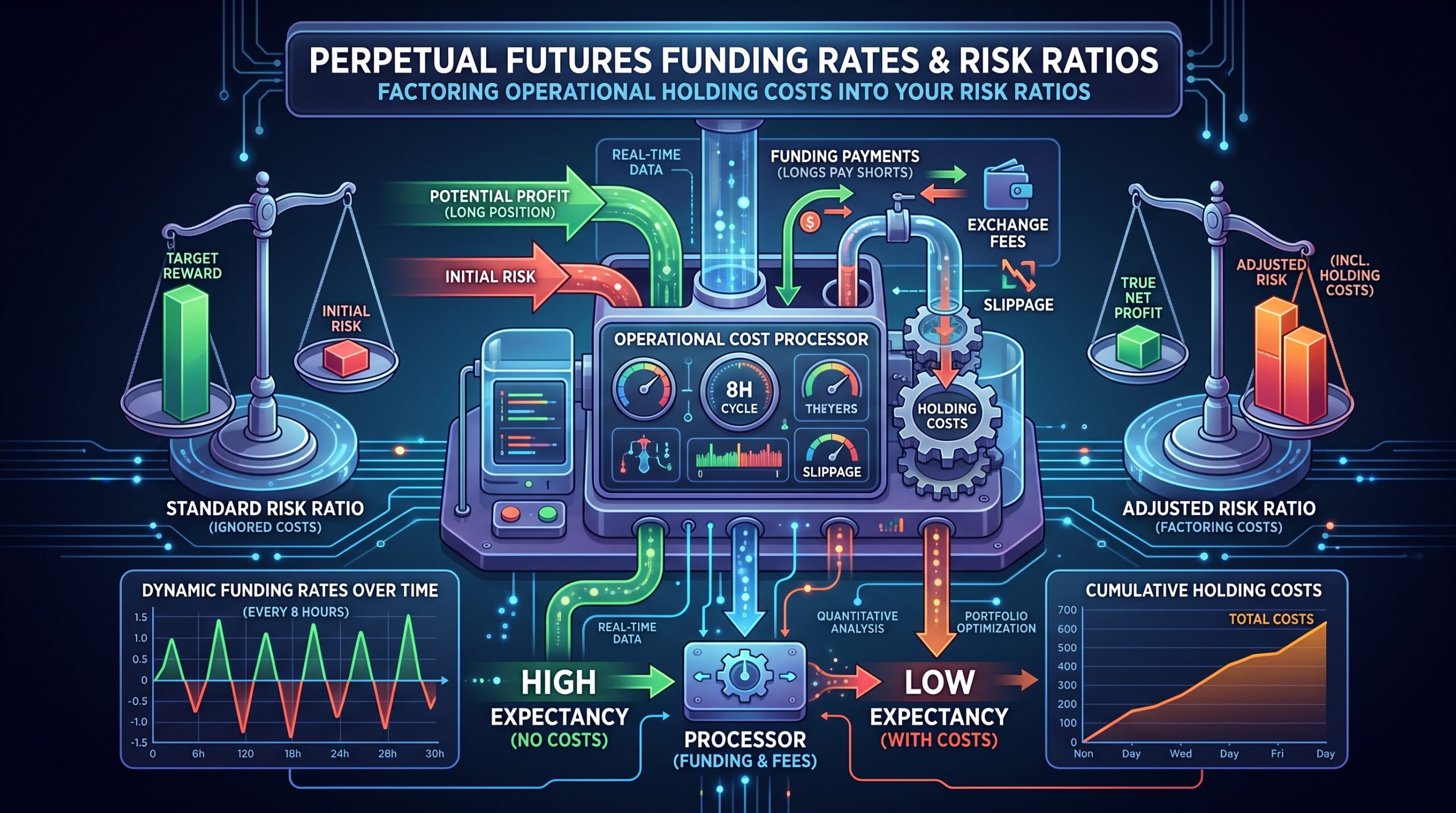
The funding rate is a payment exchanged between long and short traders to ensure the perpetual contract doesn’t deviate too far from the spot price. When the market is overly bullish, the funding rate is typically positive, meaning longs pay shorts. In a bearish market, the rate often flips negative, meaning shorts pay longs.
Expert Insight: Many retail traders treat funding as a “negligible” cost. Don’t fall into this trap. During parabolic rallies, funding can climb to 0.1% or 0.3% every eight hours. If you hold that position for a month, you could be paying 5–10% of your total position value just to keep the trade open. That is a massive headwind that you must subtract from your projected profit target before you ever click “buy.”
Factoring Funding Into Your Risk-to-Reward Ratio
Most traders calculate their risk based on price targets alone. A professional, however, calculates their “cost-adjusted” exit. If your target is a 10% gain, but your holding period incurs a 3% funding cost, your actual net gain is only 7%. If you are leveraging 5x or 10x, that percentage cost is magnified against your margin, not just the position value.
Personal Example: I once held a long BTC position for three weeks during an overheated market. I was so focused on the $75,000 price target that I ignored the funding costs, which had been positive and high for days. By the time I hit my exit, the funding payments had effectively eaten 40% of my anticipated profit. Now, I always set my exit targets 2–3% higher to compensate for projected funding, or I rotate my capital into spot if I plan to hold for more than a few days.
The “Carry Trade”: When You Become the Collector
The flip side of the coin is that you can actually earn funding. During market panics, funding rates often turn deeply negative, meaning shorts are effectively paying longs to take the other side of the trade. Seasoned traders often use this to their advantage by opening long positions specifically to harvest funding income.
Expert Insight: This is the professional “carry trade.” If you are bullish on an asset but want to hold it without the volatility of spot, you can open a long position on a perpetual contract when funding is deeply negative. You get the price appreciation if the market recovers, plus you are paid a “yield” by the panicked shorts. It’s one of the few high-probability setups in crypto where the math is genuinely working in your favor.
Strategic Timing: Exiting Before the Spike
Funding rates are updated periodically—usually every eight hours—and traders are charged only if they hold the position at the exact moment of the funding timestamp. Some of the smartest traders monitor these timers closely. They will enter a position just after a funding event and exit just before the next one if the rate is prohibitive.
Expert Insight: Check your exchange’s “Funding History” for the last 30 days. If the rate is consistently high, treat it as a “holding tax.” If you aren’t comfortable with that tax, you have two choices: reduce your time horizon or move your exposure to the spot market where there are no ongoing holding fees. Never hold a perpetual contract long-term if you haven’t done the math on the cumulative funding cost.
Perpetual futures are a precision instrument, not a “set-and-forget” tool. By ignoring funding rates, you are essentially letting the exchange bleed your capital while you wait for your price target to hit. Factor these costs into your initial risk ratio, look for opportunities to harvest yield from negative funding, and be ruthless about your holding periods. If the math of the funding rate doesn’t work for your strategy, don’t force the trade.
FAQ
Where can I see the current funding rate for my trade? Almost every professional trading interface displays the “Funding Rate” and a countdown timer next to the price chart. Check it before you open your position, as it changes dynamically based on market sentiment.
Does funding always cost me money? No. If the rate is negative, you are paid to hold a long position, and if the rate is positive, you are paid to hold a short position. You only pay if you are on the “crowded” side of the trade.
Is it better to use spot for long-term holds? Yes. If you plan on holding for weeks or months, the spot market is almost always cheaper because you don’t pay recurring funding fees. Use perpetuals for active trading and short-term trends.
Why does funding get so expensive during rallies? Because everyone is rushing to go “long,” the exchange forces the longs to pay the shorts a premium to prevent the contract price from staying significantly higher than the actual market price of the asset.