
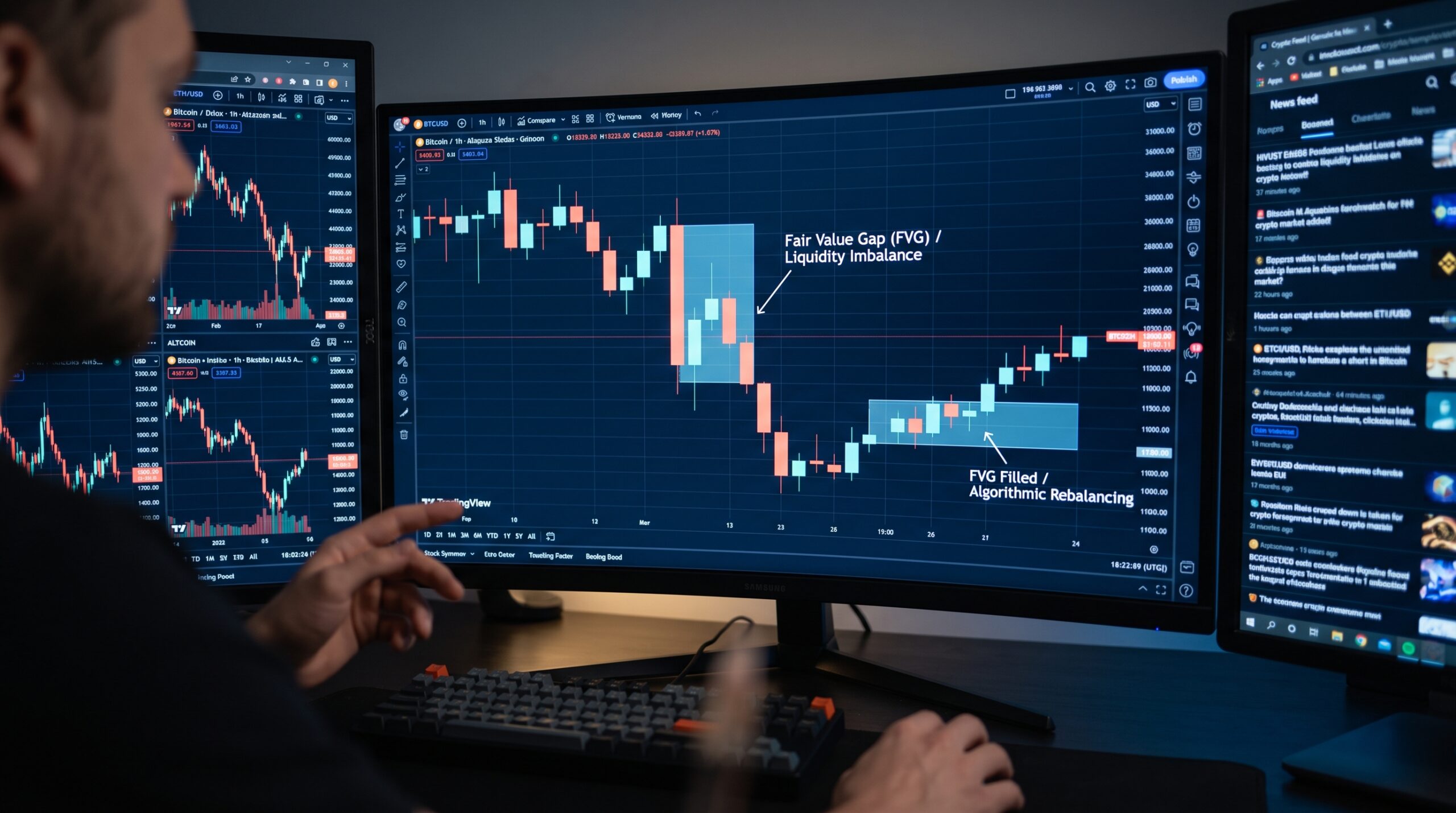
You have likely watched a chart explode in one direction, leaving behind a yawning gap in price action, and wondered if the move was “real” or just a massive manipulation. We have all been there. You feel the urge to chase the candle, but your gut tells you it’s moving too fast. That gap you are seeing isn’t just a random spike; it is a Fair Value Gap (FVG), and it is one of the most powerful signals that algorithmic market makers (AMMs) leave behind.
If you don’t understand how these imbalances work, you are essentially trading against the very algorithms that drive the market. Algorithms are programmed to ensure liquidity, and they view these gaps as “unfinished business” that must be returned to. By learning to trade FVGs, you shift your perspective from guessing where the price might go to understanding where the market is magnetically pulled.
What is a Fair Value Gap?
A Fair Value Gap occurs when the price moves so aggressively that buyers and sellers fail to exchange volume efficiently across every price level. On your chart, it appears as a three-candle pattern where the wick of the first candle and the third candle do not touch, leaving a clean “void” in the middle. This space represents an imbalance where the market pushed too far, too fast, without leaving enough liquidity for the institutional players to get fully positioned.
Expert Insight: Think of an FVG as a vacuum. Markets don’t like to leave empty space behind them. Algorithms are constantly programmed to return to these “unbalanced” areas to find the liquidity that was missed during the initial impulsive move. If you see a massive FVG, don’t assume the trend is unstoppable; assume it is temporary until the price circles back to fill the gap.
The Role of Algorithms in Filling Imbalances
Institutional market makers operate using high-frequency algorithms designed to maximize liquidity. When a move creates an FVG, it creates a “liquidity imbalance”—basically, a zone where there are too many buyers and not enough sellers (or vice versa). Algorithms view these zones as areas of inefficiency. They will often orchestrate a price pullback specifically to revisit these gaps, allowing them to fill their large-scale orders at a “fair” price.
Personal Example: I used to get caught in the “chase” every time I saw a large impulsive candle. I’d buy the breakout, only to get stopped out when the price dumped back into the FVG to fill the imbalance. Now, I do the opposite. I wait for the FVG to form, and then I set my limit orders inside the gap. It is a much higher-probability trade because I am positioning myself to capture the institutional order flow, rather than being the “liquidity” they are trying to take.
How to Trade FVGs with High Precision
To trade these gaps effectively, you must be disciplined about your entry and stop-loss placement. You don’t just buy the first touch of the FVG. Instead, you look for the price to enter the “confluence zone” of the gap, usually targeting the 50% retracement level of the imbalance.
Expert Insight: Always look for confluence. An FVG by itself is just a signpost; an FVG that aligns with a previous support/resistance level or a high-volume node is a trade setup. If the price returns to an FVG and shows a “rejection wick” or a small consolidation, that is your confirmation that the algorithm has finished filling the imbalance and is ready to resume the trend.
Risk Management Within the Gap
Trading FVGs is not a “get rich quick” scheme. Sometimes, an FVG is so powerful that it acts as a signal of a massive trend change, and the price never returns to fill it. If you are sitting on the sidelines waiting for a fill that never happens, you might miss a major move. Never build your entire strategy around waiting for a gap fill.
Expert Insight: Use the FVG as a secondary confirmation. If your technical analysis says “buy” and there is a fresh FVG nearby that could act as a pull-back zone, that is a green light. But if you are ignoring the overall market structure just to hunt for gaps, you will find yourself on the wrong side of the momentum more often than not. Protect yourself with stop-losses just outside the far edge of the gap; if the price cuts through the entire FVG, the imbalance thesis has been invalidated.

Fair Value Gaps are the “fingerprints” left by institutional algorithms, and learning to read them gives you a unique insight into the market’s hidden agenda. Instead of chasing the pump, start looking for the voids left behind. Position your trades to capture the retracement, manage your risk at the edges of the imbalance, and you will find yourself trading with the tide rather than against it. The algorithms aren’t going anywhere—so you might as well learn how they think.
FAQ
Can FVGs occur on any timeframe? Yes, but they are most reliable on higher timeframes like the 4-hour or Daily. On the 1-minute chart, FVGs are often just “noise” and are easily filled or ignored by the market.
Why does the price sometimes ignore an FVG completely? If a move is fueled by true “panic” or “FOMO,” the imbalance might be so extreme that the market leaves it behind entirely. This is called a “runaway gap,” and it is a sign of extreme trend strength.
What is the best way to identify an FVG on a chart? Look for a candle with a long body and very little wick at the ends. The space between the wick of the first candle and the wick of the third candle is your FVG.
Do FVGs work for shorting? Absolutely. If the price crashes aggressively downward, it leaves a bearish FVG. You can treat these the exact same way—looking for a “bounce” back into the gap to provide liquidity for your short entry.