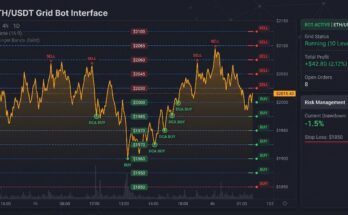

You have likely spent sleepless nights staring at charts, agonizing over whether to “buy the dip” or wait for a lower entry that never arrives. We have all been there—trying to time the volatile peaks and valleys of the crypto market, only to end up stressed, frustrated, and usually worse off than if we had done nothing at all. Human psychology is our own worst enemy; we are biologically wired to buy when the hype is loudest and panic-sell when the red candles start pouring in.
The solution isn’t to be a better trader; it is to stop being a trader entirely and start being an investor. Backtesting is the ultimate antidote to the emotional roller coaster. By simulating your strategy against years of historical data, you turn crypto from a stressful gamble into a disciplined, data-driven machine. Let’s dive into why backtesting is the single most effective tool for protecting your capital before you ever hit the “deploy” button.
The Strategy Blueprint: Defining Your Rules
Before you can test, you must have a plan that a computer can actually execute. Many traders fail because their strategies are vague, relying on “gut feeling” or subjective interpretation. To backtest successfully, your strategy must be objective: enter when X occurs, exit when Y occurs, and set your risk at Z.
Write these rules down as if you were explaining them to a child. Specify the exact indicators, the timeframe, the entry trigger, the stop-loss level, and the profit-taking criteria. If a strategy requires you to “use your intuition” at any point, your backtest will be useless because it cannot simulate human intuition. The goal is to remove the “human” element entirely, leaving only the cold, hard logic of your system.
Expert Insight: Keep it simple. We often see traders trying to combine ten different indicators into one strategy, leading to “overfitting”—where the strategy works perfectly on past data but fails in the real world. Start with one or two proven indicators, like an SMA crossover or RSI threshold, and master those before adding complexity.
Data Integrity: The Foundation of Your Test
Your backtest is only as reliable as the data you feed it. Using low-quality or “noisy” data is the equivalent of trying to build a house on quicksand. You need clean, historical price data that includes the open, high, low, close, and volume (OHLCV) for every single period of your chosen timeframe.
Look for reputable sources that offer “gap-free” data. Missing timestamps or incorrect price action can corrupt your results, leading you to believe a strategy is profitable when it’s actually leaking money. If you are serious about automated trading, invest in professional-grade historical data—it is a small price to pay to avoid the catastrophic losses of a broken bot.
Personal Example: I once ran a backtest using free data that contained significant “gaps” during major exchange outages. The bot looked legendary on paper because it skipped all the market crashes. When I went live, reality hit hard, and I realized the strategy hadn’t been tested against a single real-world flash crash. Always audit your data for outliers and missing candles before you run the test.
Modeling Real-World Friction: Slippage and Fees
Most beginners make the mistake of assuming their orders will be filled at the exact price they see on the chart. In reality, crypto markets are messy. You will face “slippage”—the difference between the expected price and the actual execution price—and trading fees that compound with every single buy and sell.
If your backtest doesn’t account for these, your profit will be a total illusion. You should apply a pessimistic penalty to every trade to simulate these costs. For top-tier coins, a penalty of 0.05% to 0.1% per trade is a good baseline; for smaller, less liquid assets, you might need to model 0.5% or even higher. If your strategy stops being profitable after adding these tiny costs, it’s not a strategy—it’s a hobby that will lose you money.
Expert Insight: Don’t just model theaverage fees; model theworst-case fees. During periods of extreme volatility, spreads widen, and exchange fees can jump. A robust strategy should be able to absorb these spikes without collapsing.
Beyond the Backtest: The Paper Trading Stage
So, your strategy passed the backtest with a great Sharpe Ratio and low drawdown. Does this mean you’re ready to deploy your life savings? Absolutely not. Backtesting is a backward-looking exercise, but paper trading—running your bot with real-time data but virtual funds—tests what no simulation can: API latency, exchange connectivity, and real-time execution stability.
Run your bot in a “paper” or “sandbox” mode for at least 30 days. This allows you to see how the bot handles API outages, how it manages orders during sudden news events, and whether your strategy logic holds up when the market isn’t “pre-recorded.” Only after the bot proves its reliability in the live environment should you consider feeding it real capital.
Expert Insight: Use this paper-trading month to observe your own behavior. Do you feel the urge to “intervene” or “tweak” the bot when it hits a losing streak? If you find yourself unable to trust your own automated logic, the problem isn’t the bot—it’s your risk management.

Backtesting is not just a preparation step; it is the most critical hurdle in your journey as a quantitative trader. By defining clear rules, demanding high-quality data, modeling real-world costs, and validating your results with paper trading, you transform your approach from gambling into a professional-grade operation. Don’t rush the process. A robust strategy built on rigorous testing is the only defense you have against the wild, unpredictable nature of the crypto markets. Start testing today, and gain the confidence that only comes from knowing exactly how your bot behaves before you bet a single dollar.
FAQ
How much historical data do I need for a reliable backtest?
Aim for at least two years of historical data. This ensures your bot has been tested against multiple market regimes, including bullish rallies, bearish crashes, and long periods of consolidation.
What is the “Sharpe Ratio,” and why does it matter?
The Sharpe Ratio measures your risk-adjusted return. A higher ratio means you are making more profit per unit of risk taken. A strategy with a Sharpe Ratio below 1.0 is often considered risky, while anything above 1.5 is usually a sign of a high-quality, stable system.
What is “walk-forward analysis”?
This is a technique where you optimize your strategy on one segment of data, then test it on the next “unseen” segment. It helps prevent “overfitting” by ensuring your bot works on data it hasn’t been trained on.
Can backtesting guarantee future success?
No. Backtesting is a guide, not a promise. Markets change, and past performance is never a guarantee of future outcomes. Use it to weed out bad ideas, not to predict the next big win.