
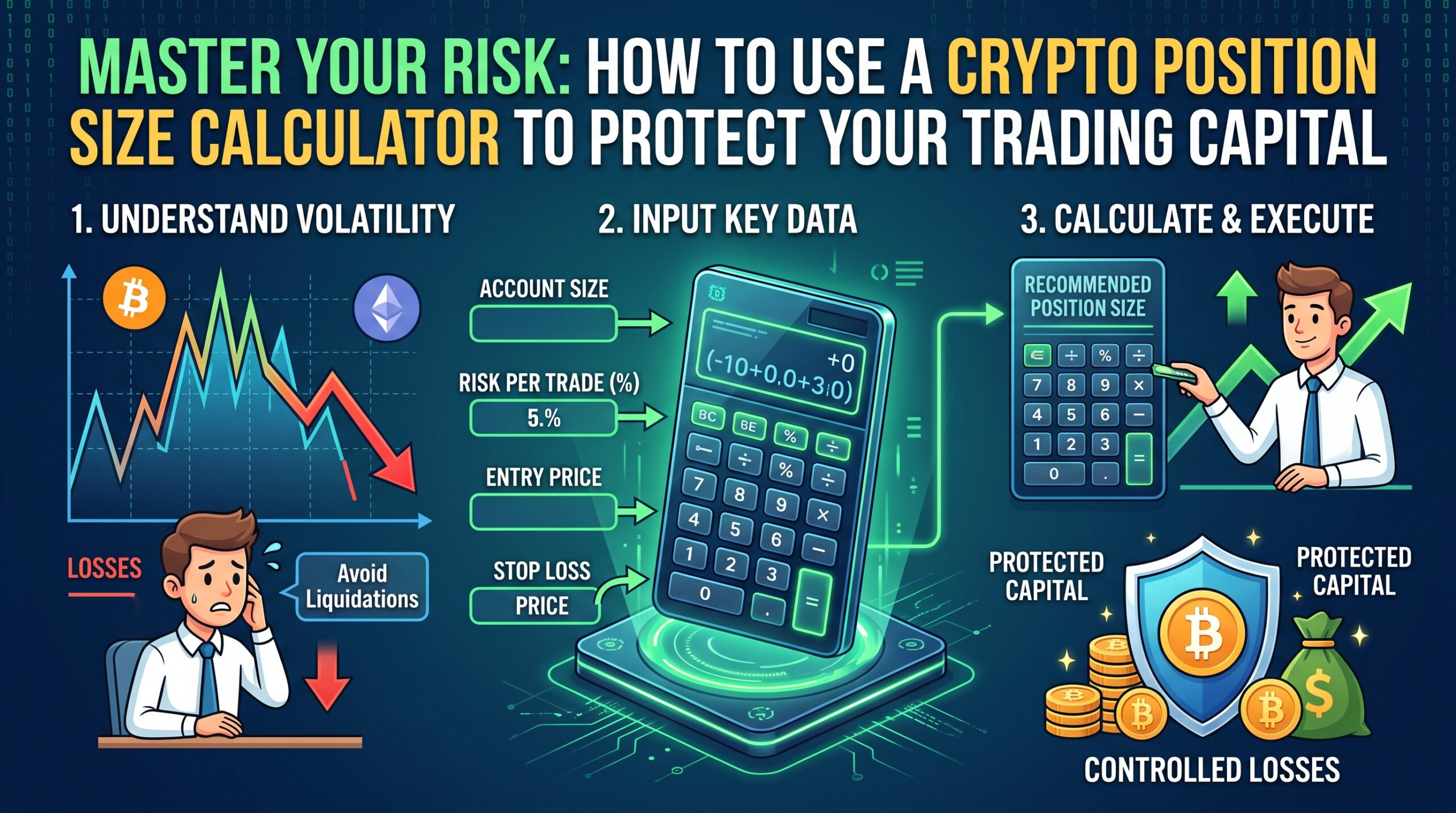
You have likely stared at a trade you felt 100% confident about, only to see the market take a sudden, violent turn that wiped out a chunk of your account before you could even blink. We have all been there. It is the classic beginner’s trap: you focus so intently on where the price is going that you completely ignore the math of how much you are actually risking. If you are entering positions without first running the numbers through a calculator, you aren’t trading—you are simply gambling on the hope that your “gut” is right.
Risk management is the defining separator between the traders who last for years and the ones who blow their accounts in a week. Using a professional-grade crypto position size calculator is not optional; it is the fundamental tool for survival. By pre-defining your risk, you effectively remove the emotional weight from your trades and transform your strategy into a calculated, mechanical process.
Why Position Sizing Trumps Market Timing
The most common misconception in trading is that your success depends on picking the “right” coin at the “right” time. In reality, even the best traders in the world are wrong nearly half the time. What makes them profitable isn’t a magical ability to predict the future; it is their ironclad commitment to never losing more than they can afford on any single bad trade.
Expert Insight: A position size calculator forces you to work backward from your pain tolerance. Instead of asking “how much profit can I make?”, you start by asking, “if this trade goes against me, how much money am I comfortable losing?” By anchoring your trade size to a fixed percentage of your account (typically 1–2%), you survive a series of losses that would destroy a less disciplined trader.
How to Configure Your Calculator for Precision
To get the most out of any position size calculator, you need to input four critical variables: your total account balance, your risk percentage, your entry price, and your stop-loss price. The calculator then tells you exactly how many units of an asset to buy. It is a simple formula, yet it is shockingly underutilized by retail participants.
Personal Example: I remember a specific trade where I was tempted to go all-in on a volatile altcoin during a breakout. My calculator told me that to keep my risk at 1%, my position size needed to be just 10% of my total account. I ignored it, bought 40%, and when the trade hit my stop-loss, I lost 4% of my total equity in one move—a blow that took me weeks to recover from. I learned the hard way that the calculator is your best friend when your emotions are at their highest.
Incorporating Leverage into Your Math
Leverage changes the game, but it also changes the risk profile entirely. A good position size calculator will always allow you to input your leverage factor, which then adjusts the “liquidation price” and the true market exposure. This is critical because leverage doesn’t just increase your potential reward; it accelerates the speed at which you hit your stop-loss.
Expert Insight: If you are using 5x or 10x leverage, your room for error shrinks drastically. Always ensure your calculator is set to your “isolated margin” level, not your total account balance. This ensures that even if you are wrong, you only lose the pre-defined amount you were willing to sacrifice for that specific trade.
The Psychological Advantage of Calculated Risk
Trading is an emotional endeavor. When you enter a trade without defined risk, every tick of the chart feels like a personal attack on your wallet. By using a calculator to lock in your risk before you execute, you can actually watch the market fluctuate without the heart-pounding anxiety of “what if.”
Expert Insight: Treat the calculator output as a non-negotiable directive. If the math says your position size is small, don’t try to “boost it up” just because you feel lucky. The goal of using these tools is to maintain a professional, cold, and mathematical approach to the market. When you know your max loss is pre-defined, you gain the clarity to let your winning trades run.

The difference between being a spectator and a trader is the discipline to control your risk. A position size calculator is the most straightforward, powerful weapon you have to ensure that a few bad trades don’t force you out of the game. Stop guessing, stop gambling, and start calculating every single entry. If you can protect your capital consistently, the market will eventually provide the opportunities you need to grow your wealth.
FAQ
Why should I limit my risk to 1–2%? Limiting your risk to 1–2% allows you to sustain a long streak of losing trades without ever facing a “ruinous” drawdown. It gives you the longevity required to stay in the market long enough for your winners to compound.
What if my trade doesn’t have a clear stop-loss? If you don’t have a clear technical stop-loss, you don’t have a trade. Never enter a position unless you know exactly at what price level you will admit you are wrong and exit the market.
Does the calculator account for exchange fees? Most calculators don’t include fees by default. As a professional habit, subtract your estimated entry and exit fees from your potential profit, or slightly adjust your risk percentage downward to account for those hidden costs.
Can I use the same calculator for spot and futures? Yes. The principles of risk are identical. The only difference is that futures require you to be more diligent about your leverage and maintenance margin requirements.