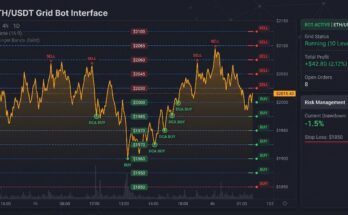

You’ve likely felt the frustration of watching your favorite crypto asset drift aimlessly for weeks. The chart moves sideways, volume dries up, and your portfolio remains stagnant. Most traders panic during these periods, desperately trying to “force” a trade or abandoning the market entirely until the next big breakout. They are missing out on the most consistent, data-driven revenue stream in the entire digital ecosystem: grid trading.
If you aren’t familiar with Setting Up a Crypto Grid Bot: Generating Passive Yield in Sideways Markets, you are effectively leaving money on the table every single time the market consolidates. This strategy isn’t about guessing if Bitcoin will moon or crash; it’s about monetizing the natural “noise” and volatility that exists in every price range. Let’s demystify how these bots turn market boredom into automated profit.
The Grid Advantage: Why Range-Bound Markets Are Gold
A grid trading bot is a sophisticated software program that automates the process of buying low and selling high within a predefined price range. It works by placing a series of limit orders at specific intervals, creating a “grid” of buy and sell orders. When the price dips to a lower level, the bot buys; when it bounces back to a higher level, the bot sells.
This approach is the ultimate weapon for sideways markets. While traditional traders get “chopped up” and stopped out by the market’s erratic movements, a grid bot thrives on them. Every oscillation is an opportunity to harvest a small slice of profit. It’s systematic, emotion-free, and runs 24/7, capturing opportunities while you sleep.
Expert Insight: Think of the grid as a “fishing net” cast at different depths. You don’t need to know exactly where the fish will swim; you just need to ensure your net is placed where they are most likely to pass. By focusing on ranging pairs—assets that lack a strong, sustained trend—you allow the bot to cycle through trades repeatedly.
Engineering Your Strategy: Setting the Perfect Parameters
Before you launch, you must define the “sandbox” where your bot will play. This means setting your Upper and Lower Price Limits. If you set these too tight, the price will quickly breakout, and your bot will stop trading while you’re left holding an unwanted position. If you set them too wide, your capital becomes too diluted, and you’ll see pathetic returns.
You also need to select the “Number of Grids.” This dictates your trade frequency. More grids mean tighter spacing and more frequent, smaller profits. Fewer grids mean wider spacing and larger potential gains per trade but fewer total transactions.
Personal Example: I once set up a grid for a popular altcoin with 50 grids in a very tight range. It was a mistake. The transaction fees ate my profit per grid, and I ended up losing money despite the bot executing hundreds of trades. Now, I always ensure my “Profit per Grid” is at least 0.3% to 0.5% after accounting for exchange commissions.
Risk Management: The Foundation of Sustainable Yield
Automated does not mean abandoned. The biggest rookie mistake is launching a bot and ignoring it until a market crash wipes out the gains. Even in a sideways market, “trend risk” is your greatest enemy. If the asset suddenly breaks out of your range due to a major news event, your bot will stop working, and you may be left holding a bag of depreciating assets.
Always implement a stop-loss order below your lowest grid level. This is the price point where the bot automatically shuts down, closes your positions, and preserves your remaining capital. Think of this as your “insurance policy” against an unexpected market catastrophe.
Expert Insight: Avoid “Over-Gridding” and keep your leverage conservative. If you are using futures grid bots, stick to 1x to 3x leverage. Grid trading relies on holding positions temporarily; high leverage in a grid bot is a recipe for liquidation if the price experiences a sharp, sudden move outside your range.
Optimization: The Fine Art of Tuning
The market regime is constantly shifting. A grid bot that performed beautifully last week might be completely irrelevant tomorrow. Once your bot is running, monitor it daily. If the price consistently hugs the top or bottom of your grid, your range is misaligned. Don’t be afraid to manually terminate the bot, reassess the support and resistance levels, and relaunch with updated parameters.
Success in grid trading is about continuous iteration. Use your exchange’s backtesting tools to see how your chosen parameters would have performed during the previous month. If the backtest shows a “flat” or downward trajectory, go back to the drawing board before risking your capital.
Expert Insight: Check the economic calendar before setting your grids. Major events like CPI data releases or Fed meetings cause massive spikes that can “wreck” a tight grid. It’s often best to pause your bots or widen your ranges significantly during periods of high macroeconomic uncertainty.
Conclusion

Setting Up a Crypto Grid Bot: Generating Passive Yield in Sideways Markets is a major level-up for any serious trader. It shifts your mindset from “guessing where the price will go” to “collecting the premium the market pays for liquidity.” While it isn’t a “get rich quick” scheme, it is one of the most reliable ways to earn consistent returns in a landscape usually defined by volatility.
Start small. Test your parameters with a modest amount of capital, track your performance, and learn the rhythm of your chosen trading pair. Once you see that first wave of automated profits hit your account, you’ll understand exactly why the pros love this market. Ready to turn those stagnant price charts into a yield-generating engine? Log into your exchange and launch your first grid today.
FAQ
What is the minimum capital needed for grid trading?
You can start with as little as $200–$500, but for meaningful results and to allow for enough grid levels, $500–$1,000 is generally recommended for major pairs like BTC/USDT.
Can grid trading work in a bear market?
Yes, but you must be careful. You can use “Neutral” or “Short” grid strategies to profit from a downtrend, but you must monitor the market closely to avoid being caught on the wrong side of a sudden, violent relief rally.
Is grid trading taxable?
In most jurisdictions, yes. Every “sell” execution is a taxable event. Keep meticulous records of your bot’s activity for your tax reporting, as the high frequency of trades can make manual tracking difficult.
What happens if the price breaks out of my grid?
The bot will stop operating because the price is outside your set boundaries. You will typically be left holding the asset (if it dropped) or stablecoins (if it rose). You can then choose to close the bot or reset your range to match the new market reality.