You’ve likely felt that gut-wrenching drop in your stomach when your favorite token suddenly plunges 10% in a matter of minutes. Crypto markets don’t sleep, and they certainly don’t play by the rules of traditional finance. We’ve all been there—staring at a flashing red chart, wondering if it’s a “buy the dip” opportunity or the start of a total collapse.
The old-school approach of staring at candles and RSI lines is no longer enough to keep you ahead. The real edge today lies in predictive intelligence. By leveraging machine learning, traders are moving beyond reaction and into anticipation. Let’s break down how these AI crypto trading tools actually read the tea leaves to predict volatility before the market moves.
The Brain Behind the Charts: Deep Learning Models
Standard technical analysis is linear; it assumes the past will repeat in a straightforward way. Machine learning, specifically deep learning, thrives on the “messy” reality of crypto. It utilizes complex architectures like Long Short-Term Memory (LSTM) networks and Gated Recurrent Units (GRU) to recognize patterns that humans simply cannot see.
These models don’t just look at price; they ingest thousands of data points every second. They process trade volumes, order book depth, and even global sentiment metrics simultaneously. Unlike a traditional GARCH model—which is great for stable assets—these deep learning frameworks excel at mapping the nonlinear “chaos” that defines a Bitcoin or Solana breakout.
Expert Insight: If you’re looking for the most robust predictive power, focus on hybrid models. The strongest AI systems today combine classic statistical methods with neural networks. This pairing allows the model to handle both the predictable “rhythm” of the market and the sudden, irrational “shocks” caused by flash crashes or news events.
Sentiment Analysis: Listening to the Crowd
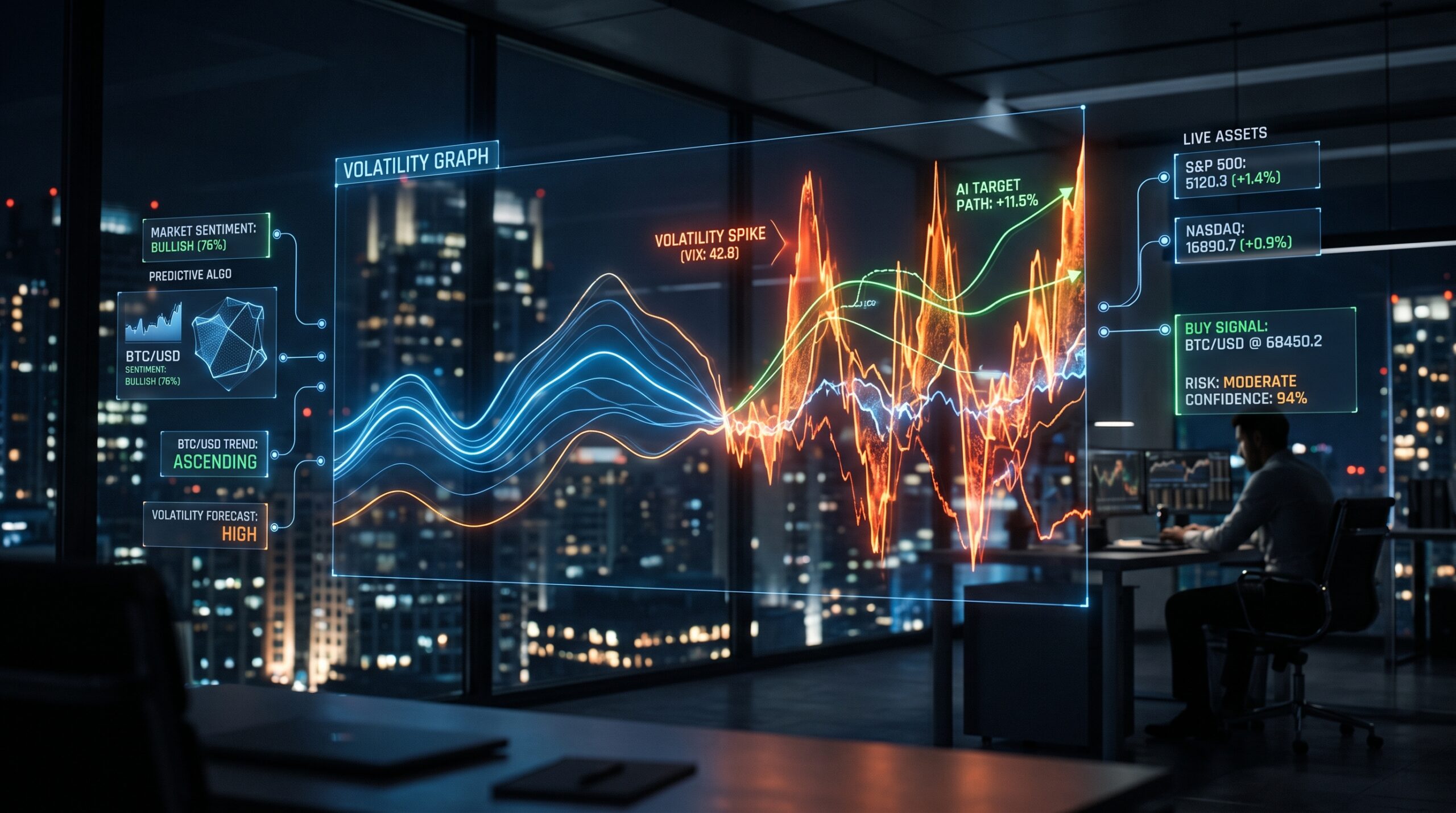
Volatility in crypto is often less about the technology and more about the narrative. AI tools have become masters at scraping social media, news feeds, and even on-chain whale alerts to gauge the “mood” of the market. When the AI detects a spike in fear or greed across these channels, it flags a higher probability of impending volatility.
This is where your advantage grows. While the average trader is panicking after a price drop, a predictive model has already correlated that drop with a massive increase in negative social sentiment and exchange inflows. It identifies the “why” behind the move, helping you differentiate between a healthy correction and a genuine panic-induced sell-off.
Personal Example: I once saw a sharp price dip that looked like a standard retracement. My AI-powered terminal, however, triggered a “High Volatility Warning” because it detected an anomaly in on-chain volume and a surge in negative sentiment across X (formerly Twitter). I stayed on the sidelines, avoiding the 15% drop that followed ten minutes later.
Real-Time Risk Management: Adaptive Automation
Predicting volatility is only half the battle; surviving it is the other. The bestai crypto trading tools for 2026 don’t just give you a “buy” or “sell” signal—they manage your risk dynamically. When the model predicts a volatility spike, it automatically widens your stop-losses or lowers your position size to keep your capital safe.
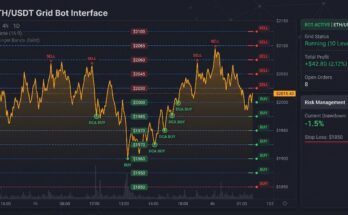
This “adaptive” nature is the key. Most trading bots are static; they follow the same rulebook regardless of whether the market is calm or spiraling. AI-driven bots, however, “rotate” their strategy based on the current regime. If the model sees volatility expanding, it shifts to a defensive grid strategy. If it sees a period of stability, it switches to trend-following.
Expert Insight: Don’t treat these tools as “set it and forget it” magic buttons. The market regime changes fast. Use these AI features to propose your entries and risk parameters, but always review the strategy before it goes live. You are the captain; the AI is simply the navigator.
Overcoming the Noise: Navigating Data Quality
The biggest hurdle for any machine learning tool is “noise.” Crypto data is notoriously messy, filled with fake volume and erratic price jumps that can confuse less sophisticated models. To get the most out of your predictive tools, you need to ensure they are being fed high-quality, cleansed data.
Look for tools that prioritize feature engineering—the process of refining raw data into actionable indicators. A model that understands the relationship between funding rates, derivative open interest, and spot prices will always outperform a model that just looks at the raw price history. If a tool doesn’t explain its input features, be wary of its output.
Expert Insight: Always cross-reference AI-predicted volatility with your own on-chain monitoring. If your tool predicts high volatility, but the order books look thin and volume is non-existent, the AI might be misinterpreting a “low liquidity” trap as a “volatility” signal.
Conclusion

Predictive AI has evolved from a luxury for institutional hedge funds into a powerful toolkit for the retail trader. By utilizing deep learning, sentiment analysis, and adaptive risk management, you can finally move from being a victim of market swings to a participant who anticipates them. Use these tools to automate your research, refine your risk, and protect your capital. The markets are volatile, but with the right intelligence, they don’t have to be unpredictable. Start testing these models with small capital today, and see how much clearer the chart becomes when the AI shows you what’s hidden under the surface.
FAQ
Can these tools guarantee a profit during high volatility?
No. Machine learning models provide probabilistic insights, not certainties. Volatility, by definition, is unpredictable. These tools are designed to manage risk and increase your edge, not to eliminate the possibility of loss.
Which AI tools are best for beginners?
Platforms like Cryptohopper and Pionex offer excellent, user-friendly interfaces that integrate AI-driven signals without requiring any coding knowledge. They are great starting points for anyone looking to bridge the gap between manual trading and automation.
How do I avoid the “overfitting” trap?
Overfitting occurs when a model learns historical noise too perfectly but fails on new, live data. To avoid this, always look for platforms that offer “walk-forward” backtesting, which tests the bot on data it hasn’t seen yet to ensure its strategy is actually robust.
Is it safe to connect my exchange API to these tools?
Generally, yes, if you follow security best practices. Always ensure you only grant “trade-only” permissions to your API keys, disable “withdrawal” permissions, and use IP-allowlisting if your exchange supports it.