You have likely opened your transaction history to copy a frequent recipient’s address, glancing only at the first few and last few characters, fully confident that the string is correct. We have all been there. It feels efficient, and in a fast-paced market, speed often feels like a necessity. But that split-second convenience is exactly where attackers are waiting to strike. If you treat your transaction history as a trusted directory, you are leaving your assets vulnerable to one of the most common and devastating traps in modern crypto:address poisoning.
When attackers “poison” your history, they aren’t hacking your keys; they are hacking your habits. They use automated scripts to generate addresses that mimic your past recipients, flooding your history with fake entries that look “close enough” to the real thing. If you aren’t actively defending your transfer habits, you aren’t just at risk—you are a target. Let’s look at how to rebuild your security perimeter around your active transfer wallets.
The Anatomy of an Address Poisoning Attack
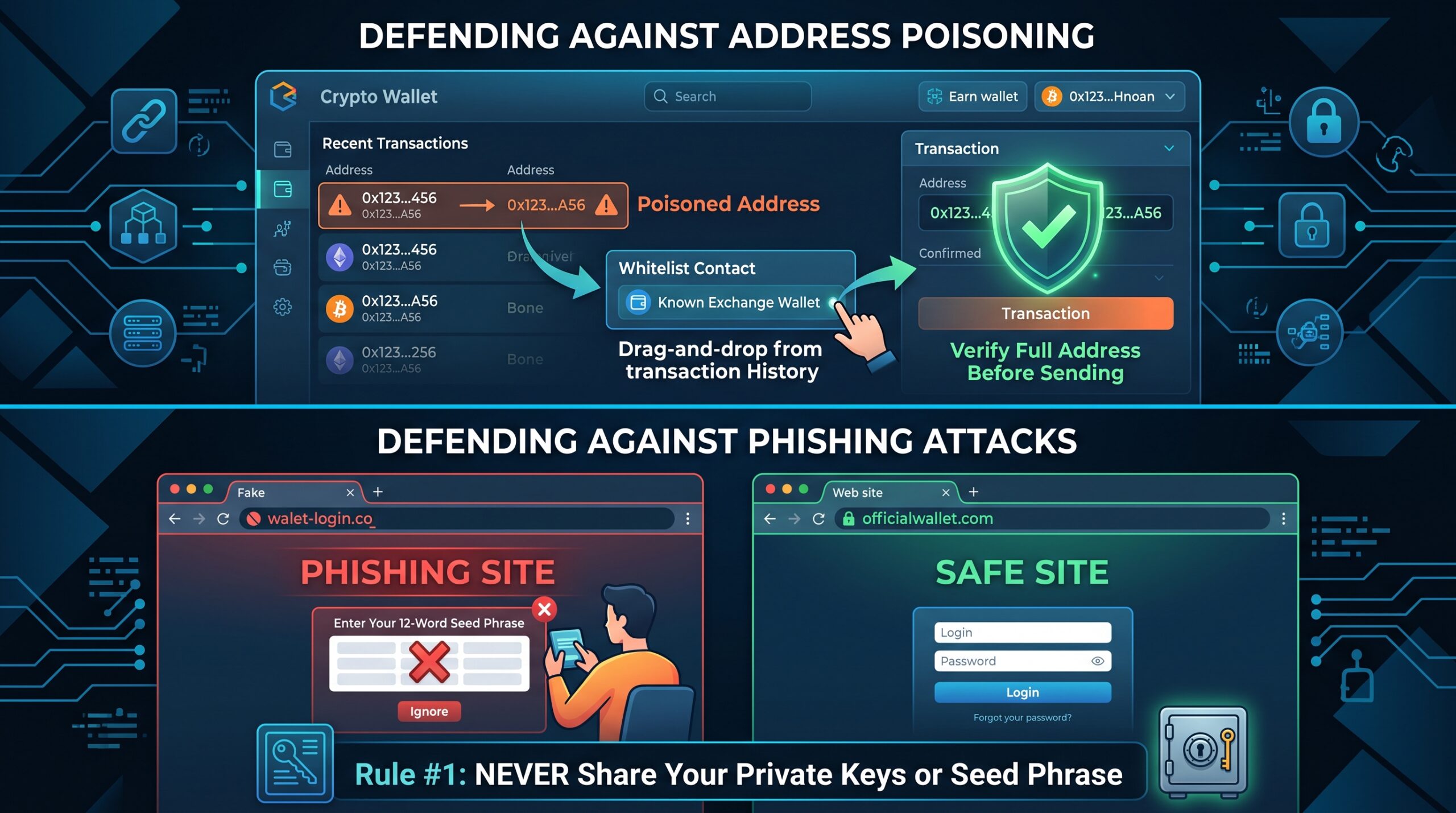
Address poisoning relies on the psychological reality that humans don’t memorize 42-character hexadecimal strings. Instead, we memorize visual shortcuts: the beginning and the end. Attackers know this, so they use “vanity” generators to create addresses that share the same first and last few characters as your exchange, your cold storage, or your trusted contacts.
Expert Insight: Many victims assume they’ve been the victim of malware or a compromised seed phrase, but address poisoning is almost entirely social engineering through interface design. By sending a tiny “dust” transaction (sometimes worth zero) from a spoofed address, the attacker forces their fake entry into your wallet’s UI. The next time you need to send funds, you instinctively copy the most recent, familiar-looking entry, unknowingly sending your assets directly to the scammer.
Beyond the First and Last Four: The Middle Character Rule
The most effective, actionable defense is the “Middle Character” rule. Because generating an address that matchesevery single character is computationally expensive, attackers focus only on the visual “anchors” at the ends of the string. The middle characters are almost always different.
Personal Example: I treat every address I send to as a “first-time” event. Even for my own hardware wallet, I never copy from history. I keep a physical or encrypted digital note of my full, verified addresses. When I verify an address, I manually check the middle eight characters—not just the start or finish. It takes ten extra seconds, but it eliminates the risk of an address substitution entirely.
Shielding Your Workflow: Best Practices for Safety
You must fundamentally change how you interact with your wallet’s user interface. Your transaction history is not a directory; it is a public record of on-chain activity that you should treat as untrusted data.
-
Use an Address Book: Always save frequently used addresses in your wallet’s built-in address book. Once saved, select by the alias, not by the transaction history entry.
-
The Test Transaction: For high-value transfers, never send the full amount at once. Send a trivial “test” amount first, verify receipt on the other side, and then use thatexact verified address for the final transfer.
-
Audit Your UI: If your wallet software doesn’t warn you about “lookalike” addresses, consider switching to a security-first wallet that proactively filters out spam dust transactions and flags potentially spoofed addresses.
Verifying the Destination: The “Block Explorer” Double-Check
If you are ever in doubt, the blockchain itself is your source of truth. Do not rely solely on your wallet’s display, which can be manipulated or cluttered by spam. Use a trusted block explorer to check the transaction history of a recipient if you need to verify they are legitimate.
Expert Insight: Many attackers use fake token contracts to spoof “transfer” events, making it appear that an address has a history of legitimate activity. If the history on the explorer looks “too perfect” or shows strange, spammy token transactions, that is a major red flag. Always cross-reference the address with an official source, such as an exchange’s direct support page or a trusted documentation source.
Address poisoning is a silent, habit-based trap that rewards the rushed and the careless. You cannot stop someone from sending spam dust to your wallet, but you can absolutely stop yourself from using that spam as a shortcut. By abandoning the habit of copying from history, enforcing the middle-character verification rule, and treating every high-value transaction as a manual audit, you build a shield that no amount of automated spoofing can bypass. Slow down, verify everything, and keep your transfer habits disciplined—because in this ecosystem, a moment of caution is the only real insurance policy.
FAQ
What should I do if I see a “dust” transaction in my history?
Ignore it. Do not attempt to “send it back” or interact with it in any way. Simply leave it alone and ensure you never use that sending address for future transactions.
Does an address poisoning attack compromise my private keys?
No. Address poisoning is a deception technique, not a protocol-level hack. Your private keys, seed phrase, and actual wallet security remain intact. The attack only succeeds if you copy the wrong address and choose to send funds to it.
Why don’t wallets automatically block these addresses?
Many modern wallets nowdo have “lookalike” detection, but as a user, you should never rely solely on software filters. Attackers are constantly iterating, and new types of address spoofing evolve faster than UI warnings.
Is there any way to recover funds sent to a poisoned address?
Unfortunately, no. Once a blockchain transaction is confirmed, it is immutable. Funds sent to an attacker’s address are irretrievable, which is why preventive verification is the only viable security strategy.