Retail brokerage accounts are experiencing massive emotional whiplash right now, watching prices wildy swing below historical peaks while wondering if the retail crypto boom has permanently hit a wall. You have likely seen your portfolio’s paper gains evaporate during recent market drawdowns, leaving you hesitant to deploy fresh capital. The mistake most casual investors make is treating digital assets like a high-leverage lottery ticket instead of an institutional risk-management tool.
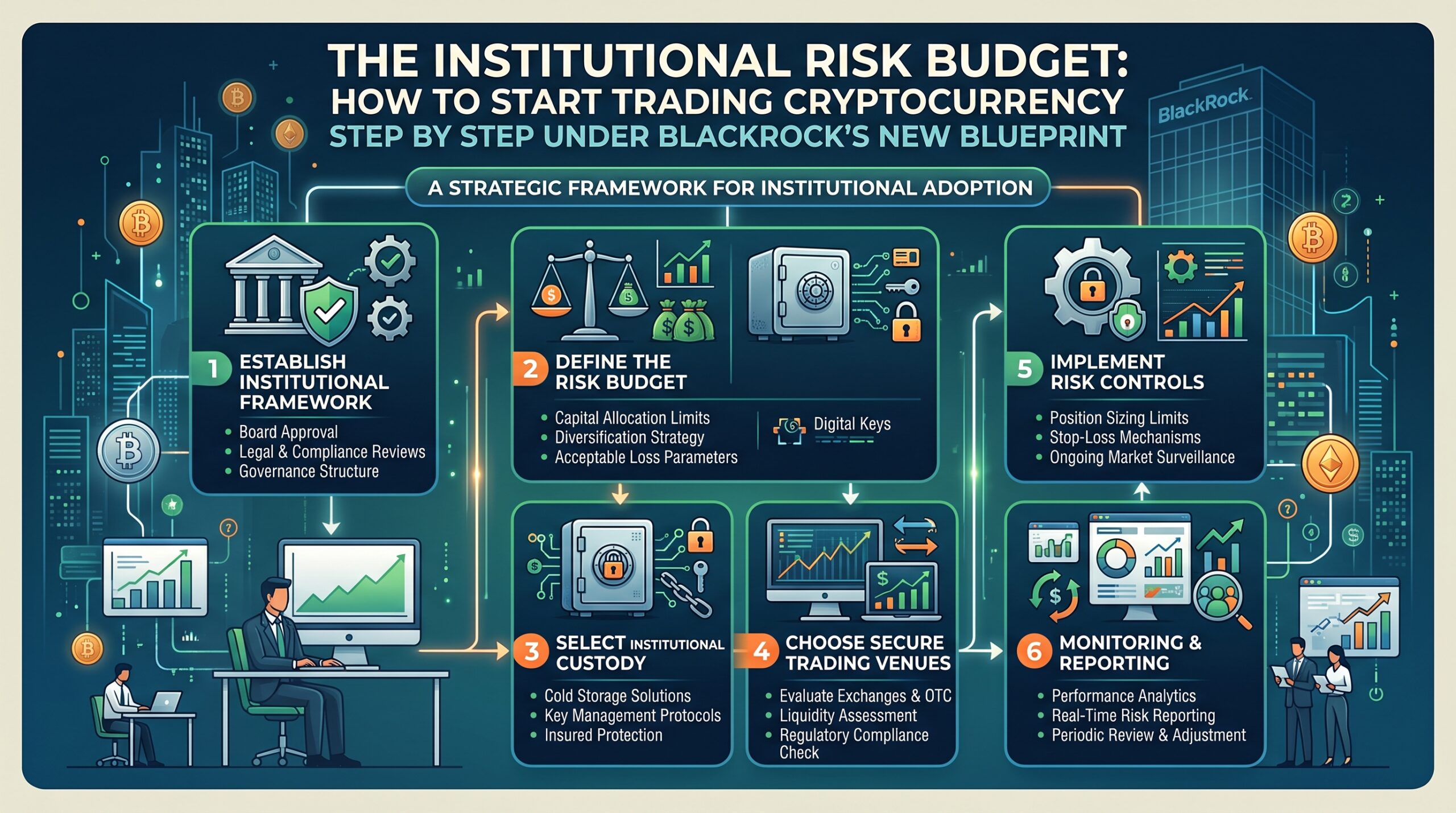
The strategy landscape completely shifted when the world’s largest asset manager dropped a major bombshell for multi-asset portfolios. In its newly released research brief, Sizing Bitcoin in Portfolios, BlackRock shares a surprising portfolio tip for investors: a modest 1% to 2% structural allocation to Bitcoin serves as an optimal “complementary diversifier” to boost overall returns without breaking your macro risk tolerance. If you want to build a sustainable, bulletproof portfolio using the exact framework wealth managers are adopting, you must learn how to start trading cryptocurrency step by step using strict institutional position-sizing rules.
Align Your Infrastructure with Institutional Custody Standards
When the BlackRock Investment Institute (BII) formally advises registered investment advisors to allocate capital to digital assets, they are not telling people to buy speculative tokens on unverified, off-shore exchanges. This structural recommendation relies entirely on the maturity of highly regulated, liquid investment vehicles like BlackRock’s own iShares Bitcoin Trust (IBIT). For everyday retail players, the absolute baseline for entry is choosing platforms that match this strict tier-one regulatory compliance.
Your very first step is to open a trading account on a prominent, state-registered digital asset exchange or through a traditional brokerage platform that provides transparent, third-party audited proof-of-reserves. Look for venues that offer direct API integrations, clear fee structures, and immediate cash gateway linkages. By executing your trades within a fully compliant, heavily audited ecosystem, you eliminate the counterparty risk that routinely destroys casual investors who chase unverified platforms promising zero transaction costs.
Mathematically Calibrate Your Personal Crypto Risk Budget
The most critical takeaway from BlackRock’s quantitative modeling is that your position sizing must replace emotional guesswork. According to their risk-contribution metrics, a clean 1% allocation to Bitcoin accounts for roughly 2% of a standard 60/40 portfolio’s global risk profile, mimicking the volatility footprint of a single mega-cap technology stock. However, scaling your position blindly can be catastrophic; expanding that allocation to 4% or higher completely dominates your portfolio’s underlying volatility.
We must practice true portfolio discipline by calculating an exact 1% to 2% capital boundary before placing a single buy order. If your entire investable net worth across stocks, bonds, and real estate sits at $100,000, your maximum combined cryptocurrency footprint should remain strictly capped between $1,000 and $2,000. This deliberate constraint allows you to capture the massive upside potential of digital asset adoption cycles while ensuring a unexpected 30% flash crash has virtually zero negative impact on your broader financial security.
Focus Exclusively on High-Liquidity Macro Assets
The era of random, micro-cap altcoins driving long-term institutional interest is rapidly drawing to a close. Wall Street wealth management channels are funneling billions exclusively into established layer-one networks because these protocols possess the deepest liquidity pools and historical track records necessary to sustain institutional capital. BlackRock’s structural framework centers entirely on Bitcoin because its mathematically capped supply curves react perfectly when met with scaling global macro demand.
When establishing your trading trajectory, ensure your core crypto allocation is heavily anchored in established macro-assets like Bitcoin and Ethereum. Treat these primary digital assets exactly like foundational blue-chip equities inside an index fund. They act as the underlying layer-one infrastructure for the entire tokenized economy, making them the direct beneficiaries of institutional passive inflows while speculative meme-assets lack any verifiable corporate backing or low-correlation utility.
Secure Assets Using Self-Custodial or Insured Multi-Asset Vehicles

While institutional wealth advisors rely on massive exchange-traded funds to safely wrap digital asset exposure for retail clients, independent market participants have a distinct choice to make regarding ownership. If you purchase spot assets directly on a centralized exchange trading interface, leaving those tokens on the platform means you are exposing yourself to potential security hacks or operational liquidity gaps.
The moment your digital asset position matches a value that would cause you genuine financial distress to lose, you must take active custody of your funds. Transition your assets onto an offline hardware wallet, which keeps your private cryptographic keys entirely isolated from internet-connected networks and malicious software exploits. If you prefer to keep your capital within traditional equity boundaries, utilize highly liquid, low-fee spot ETFs to ensure your shares are backed by institutional-grade vaults and compliant financial custodians.
FAQ
What specific portfolio tip did BlackRock share for investors?
BlackRock formally recommended that a modest 1% to 2% allocation to Bitcoin serves as an exceptional complementary diversifier for traditional portfolios. Their analysis demonstrates that this specific allocation range improves risk-adjusted returns due to Bitcoin’s historically low correlation with traditional equities and bonds.
How does a 2% Bitcoin allocation affect overall portfolio risk?
According to the BlackRock Investment Institute, a 2% allocation to Bitcoin increases a portfolio’s total risk profile by roughly 5%. This volatility contribution is effectively equivalent to adding a single, large-scale technology stock to a standard diversified balance sheet.
Can I use options strategies to generate income from my crypto holdings?
Yes, institutional platforms have recently rolled out specialized vehicles like the iShares Bitcoin Premium Income ETF (BITA), which generates monthly yield by selling covered options against a core percentage of underlying Bitcoin exposure to capture premium revenue amidst high asset volatility.