You have likely noticed the subtle, persistent shift in global finance. Every time a major nation explores bypassing the SWIFT system or settling trade in non-dollar currencies, the “de-dollarization” narrative gains a little more traction. We have all seen the headlines: nations are seeking sovereignty, and the dollar’s long-standing monopoly on global trade is being questioned. If you are still betting that Bitcoin is just a speculative tech play, you might be missing the bigger picture.
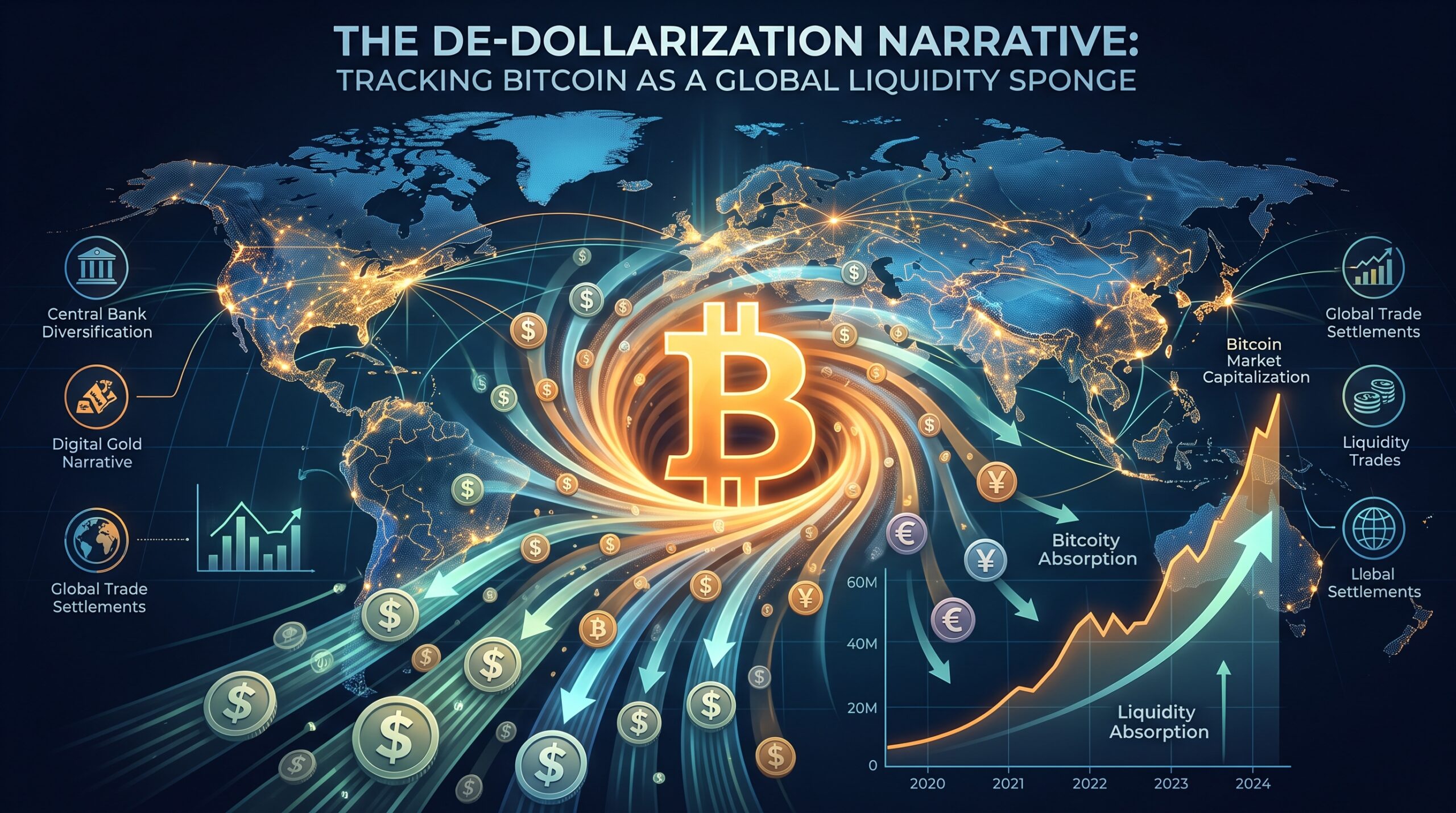
In 2026, Bitcoin is evolving into something far more structural—a global liquidity sponge. As central banks grapple with massive sovereign debt and the potential fragmentation of the world’s reserve currency system, Bitcoin is quietly absorbing the excess capital that no longer feels “safe” in traditional fiat rails. Let’s look at why this shift is happening and what it means for your portfolio.
The Fragmentation of the Global Reserve
For decades, the US dollar has been the world’s primary “trust” asset. However, the overuse of financial sanctions and the persistent growth of US sovereign debt have prompted other nations to seek alternatives. This isn’t happening overnight; it’s a slow, grinding erosion of the dollar’s dominance.
Expert Insight: Think of the de-dollarization trend as a “flight to neutrality.” When two nations disagree, they no longer want a system controlled by a third party. Bitcoin offers a neutral settlement layer that doesn’t care about geopolitics. As more cross-border trade occurs outside the dollar, Bitcoin is increasingly viewed not just as an investment, but as a “neutral reserve” that sits outside the reach of any single government’s monetary policy.
Bitcoin as the Ultimate “Liquidity Sponge”
Why do we call it a “liquidity sponge”? Because whenever global central banks inject liquidity to manage their debt—whether in the US, Europe, or beyond—that money has to go somewhere. Historically, it went into Treasuries. Today, that capital is increasingly flowing into “hard” assets.
Personal Example: I look at my allocations differently in 2026. In the past, I held cash to buy the dip. Now, I view Bitcoin as the “cash of the internet.” When liquidity is abundant, Bitcoin acts as the primary valve that captures that excess money, providing a hedge against the inevitable debasement of fiat currencies. It isn’t just “digital gold”—it’s a digital mirror of global monetary expansion.
The Institutionalization of the “Hard Asset” Trade
The days of retail-only speculation are over. Institutional capital is now the “center of gravity.” With pension funds and insurance giants integrating Bitcoin into their treasury operations, the “sponge” effect is becoming structural. They aren’t buying for a quick 20% gain; they are buying because their models show that fiat currency is losing its long-term purchasing power.
Expert Insight: Watch the corporate treasury numbers. When publicly traded companies begin holding BTC as a primary reserve asset, they are effectively “de-dollarizing” their own balance sheets. This creates a massive floor for the price, dampening volatility and forcing Bitcoin to behave more like a global macro-asset rather than a speculative tech stock.
Navigating the Geopolitical Tightrope
It is important to remember that this transition won’t be a straight line. The US dollar still provides deep liquidity and institutional stability that no other currency can match. However, the rise of stablecoins and tokenized real-world assets is essentially “digital dollarization”—extending the dollar’s reach while simultaneously digitizing it.
Expert Insight: Don’t get caught in the “us vs. them” trap. We are entering a hybrid era. You are likely to see a world where the dollar remains dominant in the short term, but Bitcoin grows alongside it as the “exit door” for those who want to opt out of the inflationary cycle. Your strategy should be to hold the asset that is hardest to debase, regardless of who is winning the geopolitical debate.

The de-dollarization narrative is far more than a political talking point; it is a fundamental shift in how global value is stored and moved. By positioning Bitcoin as your “liquidity sponge,” you are essentially preparing for a future where sovereign currency control is no longer the only option. Take a look at your portfolio and ask: are you holding assets that rely on the current system, or are you holding assets that can survive its fragmentation? The answer to that question will likely define your wealth in the coming decade.
FAQ
Is Bitcoin really “neutral” if most volume is still in USD?
Yes, in the sense that the protocol itself is permissionless. While we use USD to measure its price, the network functions independently of any central bank’s ability to freeze or censor your transactions.
Does de-dollarization automatically mean Bitcoin price goes up?
Not necessarily. It means there is a larger potential “market” for Bitcoin as a neutral store of value. It will still fluctuate based on global interest rates and macro liquidity, but the long-term “buy pressure” from central banks and corporations provides a unique tailwind.
How do stablecoins fit into this?
Stablecoins are acting as a “bridge.” They allow users to access the efficiency of digital dollars while potentially moving into Bitcoin when they decide to move out of the fiat ecosystem entirely.
What is the biggest risk to this thesis?
Regulatory overreach. If major governments coordinate to make “off-ramps” from Bitcoin impossible, it could hinder its ability to act as a liquid store of value. Keep an eye on the CLARITY Act and similar global regulatory frameworks.