
You have likely watched your crypto portfolio move in perfect lockstep with the broader financial markets, wondering why a change in interest rates halfway across the world seems to dictate the price of your digital assets. We have all felt that frustration—the feeling that your deep technical research is being steamrolled by “macro” forces you can’t control. But here is the reality: crypto does not exist in a vacuum. It is a high-beta asset tethered to the global financial plumbing.
If you are treating crypto trading as a game of patterns and project news alone, you are only playing half the game. Global liquidity—the “easy money” that flows through the system—is the true engine of market cycles. When liquidity expands, assets rise. When it contracts, markets shrivel. Let’s look at how to tune your strategy to the rhythm of the global macro environment.
The “Liquidity Barometer”: Why Global M2 Matters
Think of global liquidity, often measured by the M2 money supply, as the “tide” for all financial assets. When central banks inject capital into the system—lowering interest rates or expanding their balance sheets—that money has to go somewhere. Historically, the first stop for this “cheap” capital is the most speculative parts of the market, including technology stocks and cryptocurrencies.
Expert Insight: Don’t look for crypto-specific news to explain every move. Instead, look at the big-picture liquidity indexes. If global M2 is trending upward, you are trading in a “pro-liquidity” environment where your risk-on assets are likely to have a tailwind. When liquidity tightens, even the best project fundamentals will struggle to hold their value against the massive selling pressure of capital flight.
Institutional Reflexivity and Forced Selling
We have entered a new era of “Institutional Reflexivity.” With the rise of Spot ETFs and massive institutional custody, crypto is no longer just retail traders moving bits. It is now tied to the rebalancing logic of multi-billion dollar funds. When the macro environment turns sour, these institutions don’t just “sell a little”—they rebalance according to algorithmic risk models.
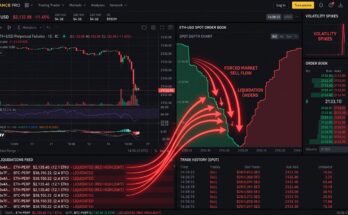
This can trigger “forced selling” effects that have nothing to do with crypto itself. If a major fund needs to cover margin calls on their stock positions, they often liquidate the most liquid assets they hold—which is increasingly Bitcoin. Understanding this means you stop seeing every sell-off as a “problem with the project” and start seeing it as an inevitable outcome of institutional portfolio management.
Aligning Your Micro-Strategy with the Macro-Trend
The biggest mistake traders make is taking “technically valid” trades that run directly against the macro tide. If the broader market is in a liquidity-contraction phase, trying to “long” every dip is like trying to swim upstream in a flood. Your technical analysis should serve as the entry mechanism, but the macro trend should be your compass.
Personal Example: I use a “Macro-Micro Alignment Score” in my trading journal. Before I enter any trade, I rate the macro environment (is liquidity expanding? is the dollar weakening?). If the macro score is low, I cap my position size at 0.5% and tighten my stops. If the macro score is high, I allow for more aggressive scaling. It’s a simple discipline, but it prevents the “emotional bias” of thinking every dip is the start of a bull run.
Watching the Dollar (DXY) as a Counter-Signal
The U.S. Dollar Index (DXY) is essentially the “inverse” of global liquidity. When the dollar is strong, global liquidity is usually being sucked into U.S. debt, making it harder for risk assets to flourish. When the dollar weakens, it effectively acts as a relief valve for global markets, freeing up capital for everything from gold to Bitcoin.
Expert Insight: When the DXY is at a multi-year high, be extremely cautious with your altcoin longs. The capital cost of risk is at its peak. Conversely, when the dollar shows signs of exhaustion and begins a multi-week decline, that is often the strongest signal to increase your exposure. It isn’t a perfect indicator, but it is one of the most reliable “macro-alerts” you can monitor on your dashboard.

Macroeconomics isn’t a distraction from your trading—it is the context for it. By monitoring global M2, watching the DXY, and acknowledging that crypto is now a high-beta institutional asset, you stop being a reactive trader and start being a strategic one. Filter out the daily headlines, focus on the flow of money, and adjust your risk to match the tide. The market moves in cycles; if you understand the macro forces that drive those cycles, you’ll spend less time fighting the market and more time surfing its waves.
FAQ
How can I track global liquidity?
You can find global liquidity charts and M2 money supply data on platforms like TradingView or by following macro-focused analysts on financial data portals. It is updated periodically, so you only need to check it once or twice a month to understand the broader trend.
Why does crypto react so violently to interest rates?
Interest rates dictate the “cost of capital.” When rates are high, there is no reason for investors to take risks on volatile assets like crypto when they can get a “guaranteed” yield in government bonds. When rates drop, that incentive disappears, forcing capital back into higher-reward assets.
Is Bitcoin a “hedge” or a “risk asset”?
In the short term, Bitcoin behaves like a high-risk tech stock, tracking liquidity and interest rate changes. In the long term, proponents argue it is a hedge against fiat debasement. Acknowledging this duality—that it acts like a tech stock during crises but a store-of-value during systemic failure—is key to managing your expectations.
Should I stop trading if the macro looks bad?
Not necessarily. It just means you should adjust your strategy. In a “liquidity-draining” environment, focus on capital preservation, take shorter-term profits, and keep a higher percentage of your portfolio in cash or stablecoins.